
1. Overview
Thermogravimetric Analysis (TGA) measures sample mass changes under controlled heating.
Evolved Gas Analysis (EGA) identifies gaseous products released during decomposition, volatilization, or oxidation in real time.
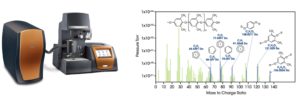
TGA-MS combines TGA with Mass Spectrometry to correlate mass loss with the chemical identity of evolved gases.
Capabilities:
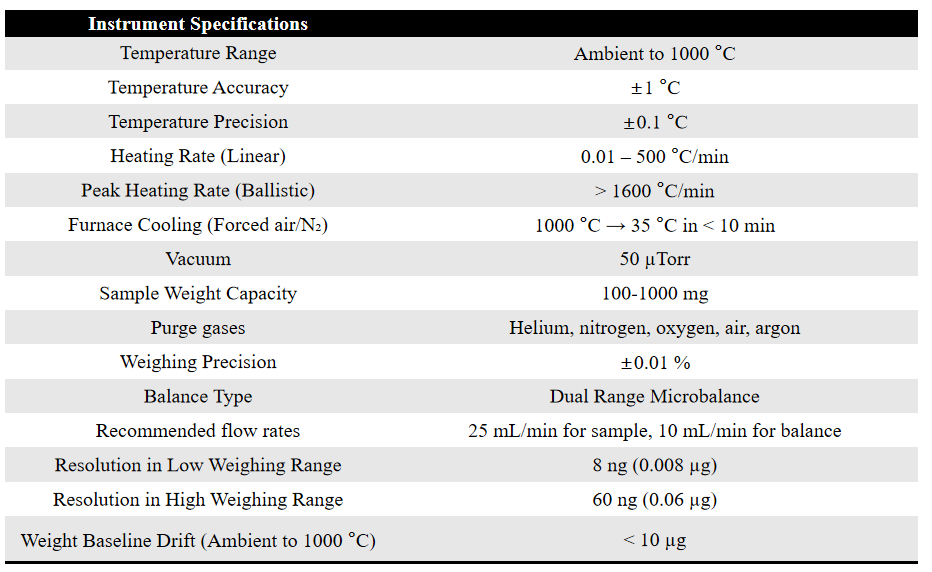
- Optimized for evolved gas analysis
- Mass range: 1-300 amu
- Mass resolution: >0.5 amu
- Quadruple detection system with parts per billion (ppb) sensitivity
2. Principle
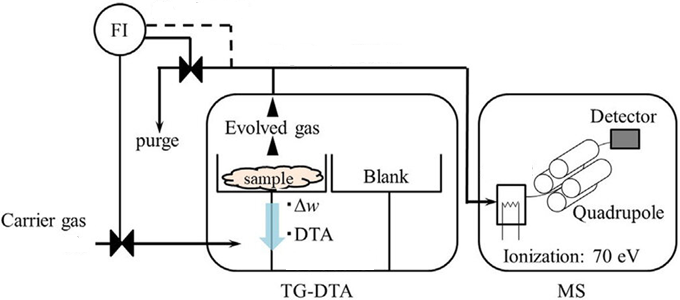
Evolved gases are transferred from the TGA to the MS through a heated transfer line to prevent condensation.
Ionization: Molecules are ionized (commonly by 70 eV electron impact) to form positive ions.
Mass Analysis: Ions are separated by mass-to-charge ratio (m/z) in a mass analyzer (e.g., quadrupole).
Detection: Ion currents are recorded using detectors such as a Faraday cup or electron multiplier.
Scanning Modes: Either a full m/z scan or a selective “peak jump” mode can be used to monitor specific ions over temperature or time.
3. Data Interpretation
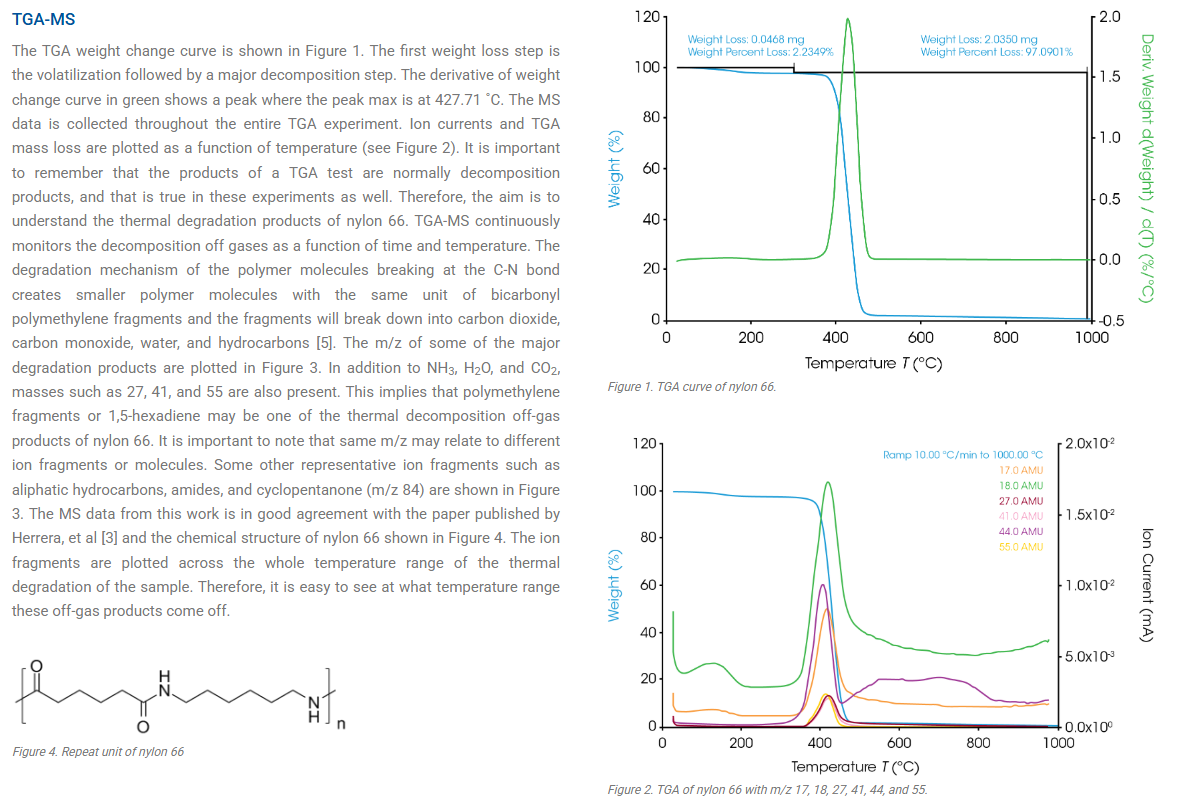
- TGA‑MS results typically display:
- TGA mass loss curve
- Derivative (DTG) curve
- Selected m/z ion signals vs. temperature
- Peaks in specific m/z channels indicate the release of particular gases (e.g., m/z 17 → NH₃, 18 → H₂O, 44 → CO₂).
- Enables assignment of mass loss events to chemical reactions or decomposition steps.
4. Example Applications
Nylon 66 degradation: Mass loss occurs around 427 °C. Characteristic m/z signals (17, 18, 27, 41, 44, 55) indicate NH₃, H₂O, CO₂, and hydrocarbon fragments.
This reveals polymer chain scission and the formation of small volatile molecules.
Blending Gas Delivery Module (GDM):
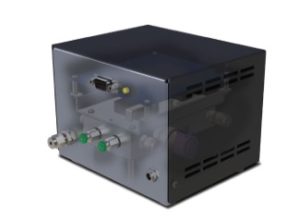
- Software-controlled switching and blending of binary mixtures of gases
- Sorption of gasses onto a material at atmospheric pressure
- CO2 uptake
- Compatible with N2, Ar, He, Air, O2, and CO2
- Redox reactions
- Thermal stability of materials in a controlled atmosphere
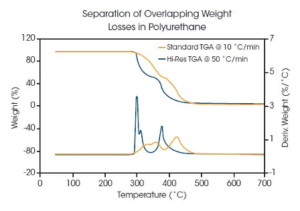 Separation of broad and overlapping weight losses
- Increased productivity with better resolution
- Rapid survey over wide temperature range with excellent resolution
- Simple method set up
- Study of the flame retardant mechanism