
1. Overview
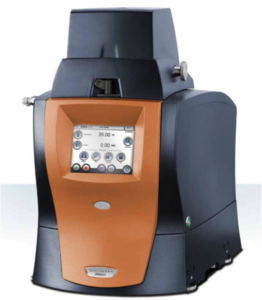
TA Instruments DMA 850 is a high-performance Dynamic Mechanical Analyzer designed to characterize the viscoelastic properties of polymers, composites, fibers, films, gels, and other soft materials. It provides precise control of temperature, frequency, deformation mode, and environment, enabling quantitative mechanical and thermal evaluation across a wide dynamic range.
Key capabilities include:
- Temperature control from sub-ambient to high temperatures
- Multiple deformation modes (tension, compression, bending, shear)
- High sensitivity to glass transition, curing, crystallization, and mechanical relaxation
- Suitable for solid samples, films, fibers, powders, and gels
Capabilities:
- Physical properties (i.e. testing of creep or cold flow, stress relaxation, cure behavior)
- Composition (i.e. degree of cross-linking, crystallinity levels, effect of filler)
- Viscoelastic properties (i.e. storage modulus, loss modulus, Tan delta, glass transition Tg)
Features:
-
- Force range: 0.0001 to 18 N
- Frequency range: 0.01 to 200 Hz
- Standard furnace: -160 to 600°C (standard furnace)
- Humidity accessory: 5 to 120°C
- Humidity range: 5 to 95%

2. Principle
DMA applies a controlled oscillatory stress or strain to the sample and measures its mechanical response as a function of temperature, time, frequency, or deformation.
The instrument quantifies:
- Storage Modulus (E′): elastic/energy-storing component
- Loss Modulus (E″): viscous/energy-dissipating component
- Tan δ (E″/E′): damping or molecular relaxation
By scanning temperature, DMA detects transitions such as:
- Glass transition (Tg)
- β and γ relaxations
- Softening and thermal degradation
By scanning frequency, DMA reveals time–temperature superposition and viscoelastic spectra.
3. Data Interpretation
Common output parameters:
- E′ (storage modulus): material stiffness
- E″ (loss modulus): molecular mobility and energy dissipation
- Tan δ: damping peak often used to identify Tg
- Creep and Stress Relaxation Curves: long-term deformation
- Modulus-Temperature Plots: determine transitions and softening points
- Master Curves: frequency-temperature dependence
Interpretation highlights:
- A peak in tan δ typically indicates glass transition temperature
- A sharp drop in E′ signals softening or structural change
- Shoulder peaks reveal secondary relaxations or side-chain motions
- Increased E′ after heating may indicate cross-linking or curing
4. Example Applications
- Polymer Characterization: Tg, crystallinity effects, segmental motion
- Composites: fiber–matrix bonding, interfacial performance
- Rubbers & Elastomers: dynamic stiffness, damping optimization
- Coatings & Adhesives: curing behavior, modulus development
- Films & Fibers: frequency-dependent viscoelasticity
- Thermosets: gelation and vitrification monitoring
- Biomaterials & Hydrogels: swelling-dependent mechanical response
Publications involving the DMA system in the experimental conditions:
- Thermo-mechanical characterization of Diels-Alder polymer networks and composites