
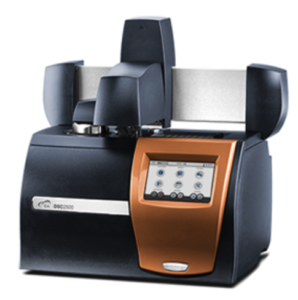
1. Overview
- DSC 2500 measures the difference in heat flow between a sample and an inert reference as both are subjected to a controlled temperature program.
When the sample undergoes a thermal event (melting, crystallization, glass transition, curing, oxidation, etc.), it absorbs or releases heat, detected as a change in heat flow.
Capabilities:
- Direct heat capacity measurement
- Glass transition Tg
- Crystallization
- Melting
- Oxidation
- Decomposition
Features:
- Temperature range: -90 to 550°C
- Temperature accuracy: ±0.025°C
- Temperature precision: ±0.005°C
- Enthalpy precision: ±0.04%

2. Principle
- The instrument maintains both the sample and reference at the same temperature.
- Any temperature difference due to a thermal event causes the system to adjust the heat flow to restore equilibrium.
- The heat flow difference (ΔQ/Δt) is directly proportional to the enthalpy change (ΔH) or specific heat capacity (Cp) of the sample.
- Endothermic events (melting, dehydration) require additional heat input → positive heat flow.
- Exothermic events (crystallization, oxidation) release heat → negative heat flow.
Reference: TA469.pdf
3. Data Interpretation
- DSC measures the heat flow associated with thermal transitions as a function of temperature or time.
- Typical DSC Results Include:
- Heat Flow vs. Temperature Curve: Displays endothermic and exothermic transitions.
- Thermal Events Identified:
- Glass transition (Tg): Step change in baseline (no latent heat).
- Crystallization (Tc): Exothermic peak indicating ordered structure formation.
- Melting (Tm): Endothermic peak corresponding to phase change.
- Thermal degradation: Exothermic or endothermic shifts at high temperatures.
4. Example Applications
- Pellet Thermal Behavior (1st Heat, As Received):
- Lower curve values attributed to water plasticizing effect.
- ΔCP at glass transition linked to amorphous phase content.
- Large relative standard deviation likely due to processing conditions of as-received samples.
- Melting temperatures (TM) and heats of fusion (ΔHF) show no clear correlation with fraction of added recycle.
Publications involving the DSC system in the experimental conditions:
- Study of the influence of alkene stereochemistry over thermal behaviour of the macromolecules
- Study of the thermal performance of phase change materials embedded 3D printed objects
- Thermal performance of phase change materials embedded in 3D printed objects and polymer gels
- Temperature- and creep-resistant Diels-Alder salogels for shape stabilization of salt hydrate phase change materials |Journal of Materials Chemistry A
- Hybrid polymer salogels for reversible entrapment of salt-hydrate-based thermal energy storage materials |ACS Applied Engineering Materials
- Strong, thermo-reversible salogels with boronate ester bonds as thermal energy storage materials |Journal of Materials Chemistry A
- Determination of glass transition and bond dissociation temperature of stereoisomers of dynamic covalent Diels-Alder crosslinks
- Stereochemical shape morphing in Diels-Alder polymer networks |Small
- Supersonic puncture-healable and impact resistant covalent adaptive networks |Materials Horizons
- Dynamic polymer network conductive composites: Low percolation threshold and Joule-heating induced network plasticity |Chemical Engineering Journal
- Thermodynamics and stereochemistry of Diels-Alder polymer networks: role of crosslinker flexibility and crosslinking density |Macromolecules