
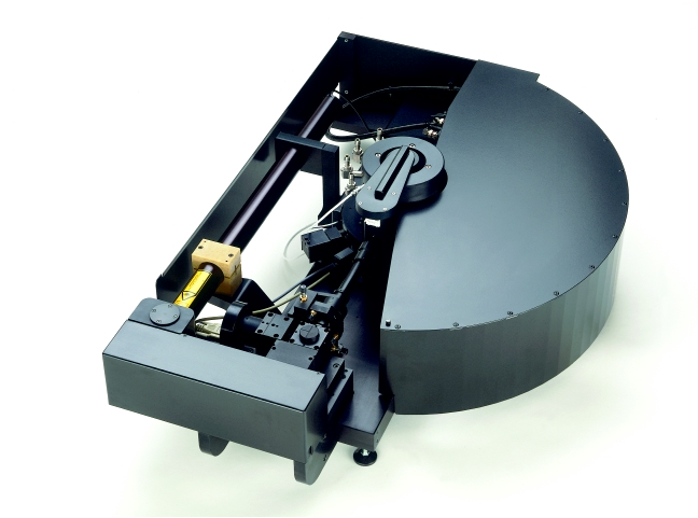
1. Overview
The ALV/CGS-3 Static Light Scattering (SLS) system is a high-precision instrument designed for measuring absolute molecular weights, sizes, and interactions of macromolecules, nanoparticles, and colloidal systems. With its advanced multi-angle detection capability, it provides accurate characterization of polymers, proteins, and complex particulate systems in solution. This system is widely used in research and industrial applications where precise molecular information is required.
Capabilities:
- Molecular weight
- Radius of gyration
- 2nd virial coefficient
Features: 
2. Principle
Static light scattering measures the intensity of light scattered by a sample at multiple angles. The scattered light intensity is related to the molecular weight, size, and structure of the particles or macromolecules in solution.
Working Principle:
- A monochromatic laser illuminates the sample solution.
- Scattered light is detected at multiple angles around the sample.
- The scattering intensity I(θ) at each angle θ is measured.
- Using the Rayleigh equation and Zimm or Berry plots, absolute molecular weight (Mw) and radius of gyration (Rg) are determined:

3. Data Interpretation
Data from ALV/CGS-3 is typically analyzed using Zimm or Berry plots, which provide:
- Weight-average molecular weight (Mw): Determined from the intercept of the plot.
- Radius of gyration (Rg): Derived from angular dependence of scattering.
- Second virial coefficient (A2): Indicates polymer-solvent interactions.
Interpretation Tips:
- Linear Zimm plots indicate monodisperse systems.
- Curvature suggests polydispersity or interactions.
- Positive A2 indicates good solvent conditions; negative A2 suggests aggregation or poor solubility.
4. Example Application
Polymer Characterization:
- Determining the molecular weight and size of synthetic polymers in solution.
- Monitoring polymerization reactions in real time.
Protein Studies:
- Measuring protein aggregation or oligomerization.
- Determining protein molecular weight in native conditions without labeling.
Nanoparticle Analysis:
- Characterizing size and aggregation behavior of colloidal nanoparticles.
- Assessing stability and interactions in complex media.
Case Example:
A research team used ALV/CGS-3 to measure the radius of gyration of a 50 kDa protein at different pH levels. The system detected subtle conformational changes, revealing pH-dependent unfolding behavior.