

<3D printed bear captured with Stereomicroscope>
1. Overview
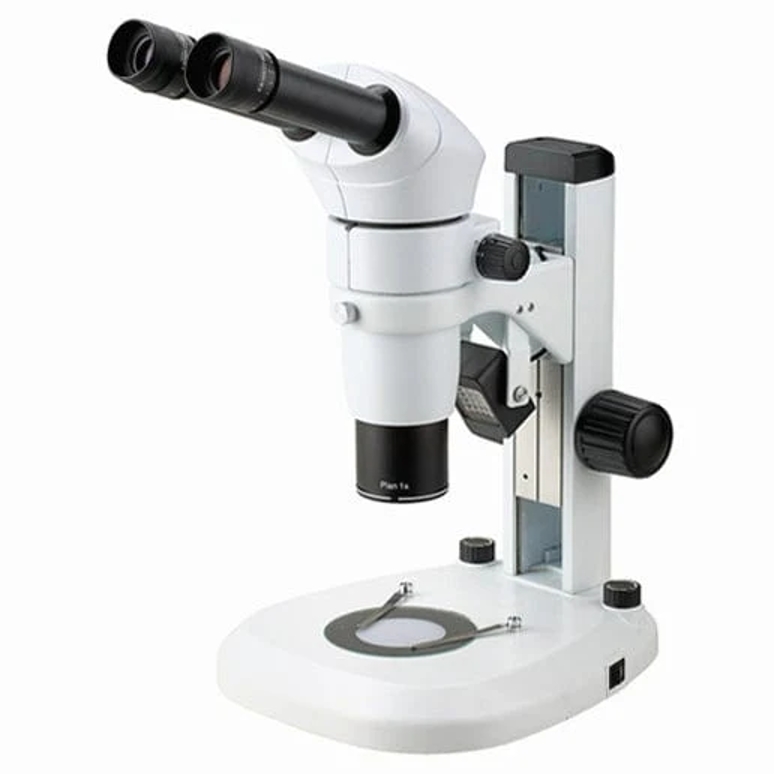
The AmScope PM240 Series is a high-performance stereo microscope designed for detailed inspection, quality control, biological dissection, and general laboratory use. It features a continuous 0.8×–8× zoom range (8×–80× with 10× eyepieces), widefield optics, and both reflected and transmitted LED illumination. The ergonomic 20° inclined binocular head and long working distance make it suitable for extended use and sample manipulation.
Capabilities
- Virtually three-dimensional objects
- Polarization filter attachable
Features
2. Principle
The PM240 uses a common-main-objective (CMO) stereoscopic optical system, which maintains parallel optical paths to produce a true three-dimensional image with high depth of field and minimal distortion.
- Zoom System: Allows smooth magnification adjustment without refocusing.
- Reflected (top) LED illumination: For opaque materials such as metals, electronics, or surfaces.
- Transmitted (bottom) LED illumination: For transparent or semi-transparent samples such as thin films, biological specimens, or fibers.
The combination of CMO optics and dual illumination provides flexibility for a wide range of sample types.
3. Data Interpretation
- Magnification & Field of View:The 0.8×–8× zoom module provides a practical 8×–80× magnification range with standard eyepieces. Lower magnification offers a wider field of view for general inspection, while higher magnification reveals fine structural details.
- Depth of Field & Working Distance:The CMO system delivers a large depth of field and a long working distance (≈ 78 mm), allowing users to observe textured surfaces and manipulate tools or samples under the microscope.
- Image Quality:The optical design ensures sharp, low-distortion images across the zoom range. Adjusting top and bottom LED intensity helps enhance surface contrast or reveal internal structures depending on sample type.
4. Example Applications
- Electronics & PCB inspection – Solder joint evaluation, micro-defect identification, component alignment, and rework.
- Materials science & QC – Surface morphology analysis, fiber and textile inspection, fracture or failure observation.
- Biological dissection & sample preparation – Dissection, sorting, embryo work, or organism handling where depth perception is important.
- Education and general laboratory use – Routine observation, classroom demonstrations, and training labs requiring robust, user-friendly stereomicroscopy.