
1. Overview
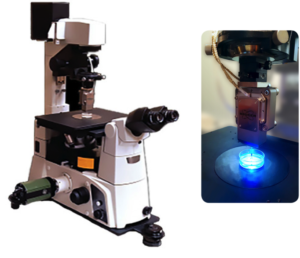
Bruker Hysitron BioSoft Indenter is a low-force, high-sensitivity nano- and micro-mechanical testing system designed for characterizing the mechanical properties of soft biological samples, hydrogels, tissues, polymers, and other compliant materials. It enables quantitative indentation under physiological or hydrated environments, delivering precise measurements of elastic modulus, viscoelastic response, creep, and force–displacement behavior at forces down to the micro-Newton level.
Key capabilities
- Ultra-low load indentation optimized for soft matter
- Quantitative modulus mapping and force–volume analysis
- Hydrated, temperature-controlled biological testing
- Compatible with optical microscopy for site-specific probing
- Ideal for gels, cells, tissue sections, thin films, and biomaterials
Features
- Integrates with an inverted microscope for maximum test flexibility
- Synchronizes powerful mechanical and optical characterization techniques
- Characterize specimens on the sub-cellular to tissue level
- In-situ observation during mechanical testing
- Access to physiological pressures from Pa → kPa
- Open platform allows testing in fluidic and environmental control.
- Customizable probes

2. Principle
The BioSoft Indenter applies a controlled force through a calibrated probe and records the resulting indentation depth, generating a quantitative force–displacement curve.
From this curve, models such as Hertzian and viscoelastic contact mechanics are used to extract mechanical properties.
Core measurable properties
- Elastic modulus (Young’s modulus)
- Viscoelastic relaxation and creep deformation
- Yield and fracture in compliant materials
- Time-dependent mechanical response under constant load
Optical integration allows users to visually locate testing sites on heterogeneous biological samples.
3. Data Interpretation
Typical outputs
- Force–displacement curves: raw mechanical response
- Elastic modulus: extracted from the loading curve using soft-material contact models
- Creep curves: deformation vs time under constant load
- Viscoelastic recovery: deformation rebound after unloading
- Spatial mechanical maps: modulus or stiffness distributions across a surface
Interpretation features
- Steeper loading slope indicates higher stiffness
- Significant hysteresis between loading and unloading reflects viscoelasticity or dissipation
- Creep rates distinguish liquid-like from solid-like behavior
- Spatial mapping reveals mechanical heterogeneity in tissues or gels
4. Example Applications
- Hydrogels and polymer networks: modulus tuning, swelling effects, viscoelasticity
- Biological tissues: stiffness differences in healthy vs pathological samples
- Cell mechanics: probing local stiffness at the microscale
- Biomaterial scaffolds: mechanical optimization for tissue engineering
- Thin soft coatings: indentation modulus and creep behavior
- Soft adhesives and pressure-sensitive materials: tack and recovery
- Pharmaceutical gels and formulations: texture and mechanical tuning