
1. Overview
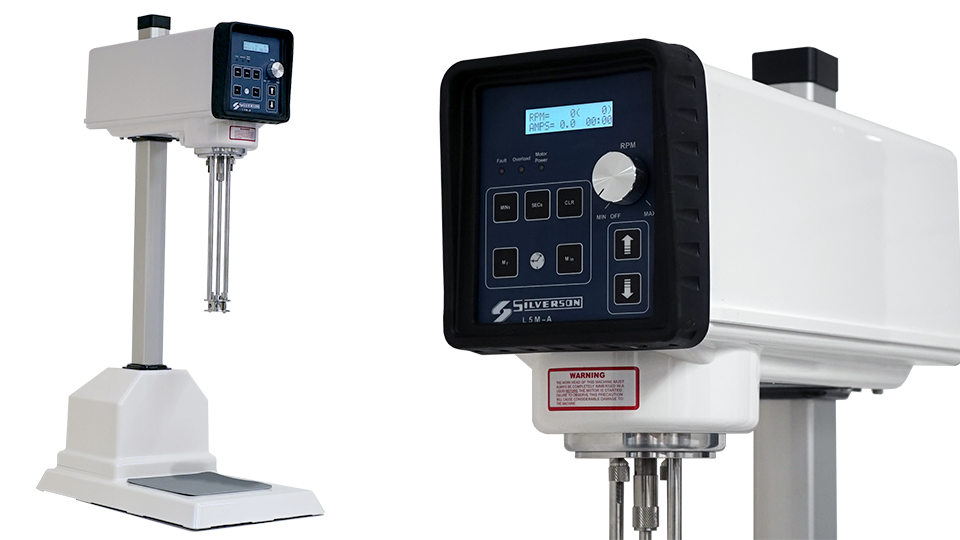
The Silverson L5M-A High Shear Laboratory Mixer is a compact, bench-top high-shear mixing system designed for research, product development, quality assurance, and small-scale production. It combines precision digital control with proven rotor/stator technology to deliver rapid, reproducible mixing performance. With a typical working capacity from milliliters up to approximately 12 liters (depending on viscosity and configuration), the L5M-A is widely used for formulation development and process optimization. Its scalable mixing mechanism enables laboratory results to reliably predict production-scale performance.
2. Principle
The L5M-A operates using a high-speed rotor/stator workhead system that generates intense mechanical and hydraulic shear forces.
During operation:
- The high-speed rotor creates suction that draws material into the mixing head.
- Centrifugal force drives the material outward into the narrow gap between rotor and stator.
- Intense shear, turbulence, and mechanical action reduce particle size, break agglomerates, and disperse immiscible phases.
- Processed material is expelled through the stator openings at high velocity and recirculated continuously through the batch.
This multi-stage shear mechanism enables rapid emulsification, homogenization, dispersion, and dissolution far beyond the capabilities of conventional stirrers or overhead mixers.
Key system features include:
- High-speed rotor/stator shear mixing
- Infinitely variable speed control
- Digital tachometer display
- Programmable timer
- Amperage (load) monitoring
- Interchangeable workheads for application-specific processing
3. Data Interpretation
The quality of high-shear mixing is determined by several key parameters:
- Rotor Speed (Shear Intensity):Higher rotor speeds increase shear rate, accelerating particle or droplet size reduction. This typically produces finer emulsions and more uniform dispersions.
- Mixing Time:Insufficient mixing may result in incomplete dispersion, while excessive mixing can affect temperature, viscosity, or structural integrity of sensitive materials.
- Workhead Selection:Different stator designs influence flow pattern and shear profile. Selecting the appropriate workhead is critical for achieving desired particle size distribution and homogeneity.
- Power Draw / Amperage Monitoring:Motor load provides indirect insight into viscosity changes and process progression. Stable amperage indicates steady processing conditions and improved reproducibility.
- Users typically evaluate output quality through particle size analysis, droplet size distribution, viscosity measurement, or visual homogeneity assessment.
4. Example Applications
The L5M-A high-shear mixer is widely used across academic and industrial laboratories.
- Emulsification of oil–water systems
- Homogenization of suspensions and dispersions
- Incorporation and wetting of powders into liquids
- Preparation of polymer blends and composite slurries
- Pharmaceutical and biotechnology formulation development
- Cosmetic and personal care product development
- Food and beverage R&D
- Scale-up feasibility and process optimization studies