
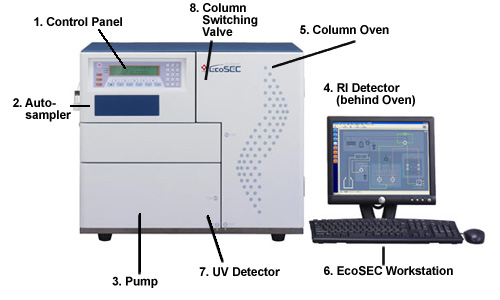
1. Overview
Gel Permeation Chromatography (GPC) is a separation method for the determination of molecular weight averages (Mn) and molecular weight distribution (PDI=Mw/Mn). GPC separates molecules on the basis of hydrodynamic size rather than molecular weight. The large molecules move more rapidly through the GPC column, and in this way the mixture can be separated.
In addition to the built-in refractive index and UV detectors, this GPC is also equipped with a Wyatt Technologies TREOS three-angle light-scattering detector (useful for absolute molecular weight determination) and a Wyatt ViscoStar detector (measures specific viscosity, which can be used to derive the intrinsic viscosity). Intrinsic viscosity is best utilized together with molar mass information from light scattering to derive the hydrodynamic radius, conformation, and branching ratio of a macromolecule in solution.
Features:
| Solvent | DMF, DMF/LiBr, THF, Toluene, Chloroform, DMSO, NMP, ACN, HFIP |
|---|---|
| Sample Preparation | Filtered through 0.2 μm membrane before testing |
| Molecular Weight (Mw) Range | 1,000 – 1,000,000 Da |
| Suitable Samples | Polymerization mixtures, block copolymers, random copolymers |
| Sample Injection Volume | 10 μL |
| Sample Volume | Minimum 3.5 mL |
| Flow Rate | Approx. 1 mL/min (adjustable) |
| Temperature | Ambient (~room temperature) |
2. Principle
Gel Permeation Chromatography (GPC), also known as Size Exclusion Chromatography (SEC), separates polymer molecules based on their hydrodynamic volume. The TOSOH GPC system employs a series of porous columns packed with cross-linked polymer beads. As a polymer solution passes through the columns:
- Larger molecules are excluded from entering the pores and elute first.
- Smaller molecules penetrate the pores and elute later.
The instrument measures the elution time of polymers and, with calibration using standard polymers, calculates molecular weight distribution, average molecular weight (Mn, Mw), and polydispersity index (PDI).
Detectors used:
- Refractive Index (RI) detector
- Optional: UV detector for polymers with chromophores
3. Data Interpretation
The GPC system outputs chromatograms showing detector response versus elution volume or time. Key parameters include:
- Number-average molecular weight (Mn): Average molecular weight of polymer chains.
- Weight-average molecular weight (Mw): Weighted average that emphasizes larger molecules.
- Polydispersity Index (PDI = Mw/Mn): Indicates molecular weight distribution; PDI close to 1 means uniform polymer chains.
- Molecular weight distribution curve: Shows the spread of polymer chain lengths.
Using TOSOH’s software, raw chromatograms are converted into molecular weight distributions through calibration curves. The software can also integrate peaks, calculate averages, and generate reports for publication or quality control.
4. Example Applications
- Polymer Research: Determining molecular weight and distribution of newly synthesized polymers such as polystyrene, polyethylene glycol, or polyacrylates.
- Quality Control: Ensuring batch-to-batch consistency of commercial polymers.
- Biopolymers: Characterizing polysaccharides, proteins, and other biomacromolecules.
- Industrial R&D: Optimizing polymer properties such as viscosity, strength, or solubility by monitoring molecular weight changes.
Example:
A research team synthesized a new water-soluble polymer. Using TOSOH Ambient Temperature GPC, they determined Mn = 45,000 g/mol, Mw = 60,000 g/mol, and PDI = 1.33, confirming a moderately broad molecular weight distribution suitable for their intended application.
Publications involving the GPC system in the experimental conditions:
- Measure absolute molecular weight of Nonionic star polymers