
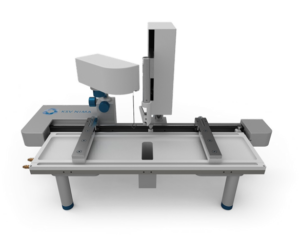
KSV NIMA medium LB Trough
Available accessories: Brust Angle Microscopy, Surface Potential Sensor
1. Overview
Langmuir–Blodgett (LB) Technique:
- LB is a method to transfer monolayers or multilayers of amphiphilic molecules from the air–water interface onto solid substrates vertically.
- Widely used to fabricate well-ordered thin films for electronics, sensors, optics, and nanomaterials.
Langmuir–Schaefer (LS) Technique:
- LS is a horizontal deposition technique where a monolayer at the air–water interface is transferred horizontally onto the substrate.
Especially suitable for fragile or sensitive monolayers and substrates that cannot withstand vertical dipping.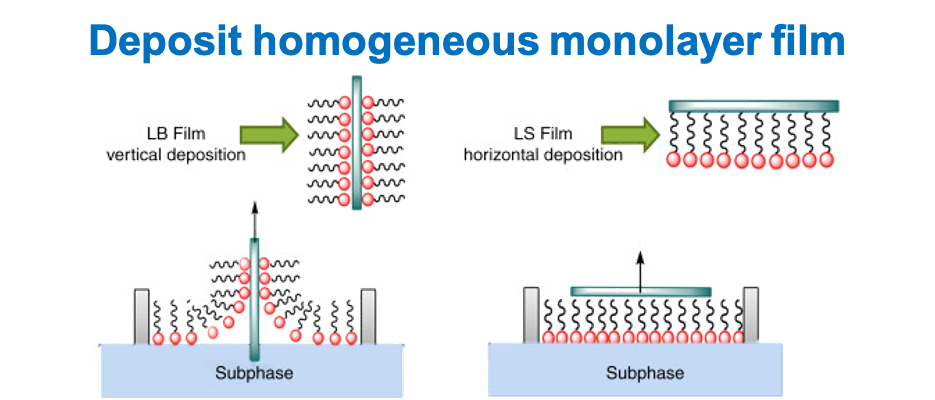
 Features

2. Principle
LB Principle:
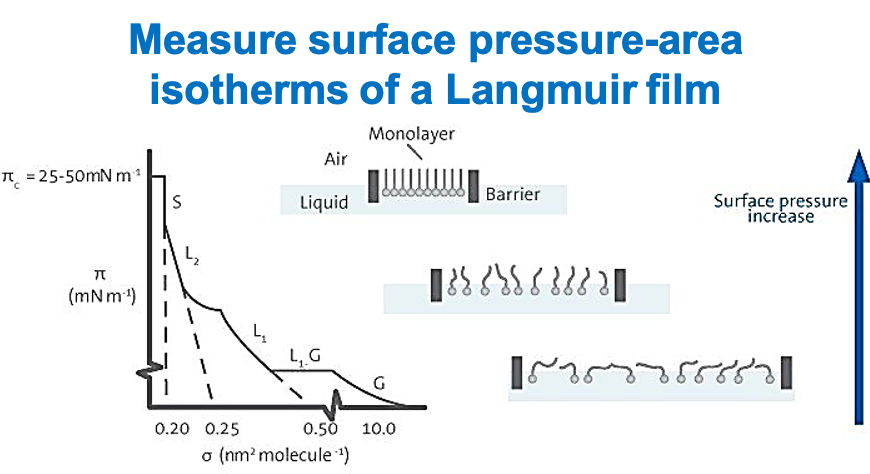
- Amphiphilic molecules (hydrophilic head, hydrophobic tail) form a monolayer at the air–water interface.
- Compression controls surface pressure and molecular packing.
- A substrate is vertically dipped through the monolayer, transferring the film onto the solid surface.
- Repeated dipping builds multilayer films with controlled thickness.
LS Principle:
- Similar monolayer formation and compression on a Langmuir trough.
- Substrate is touched horizontally onto the monolayer, lifting the film gently onto the substrate.
- Maintains molecular orientation and minimizes stress on delicate films.
3. Data Interpretation
Film Characterization after Transfer (LB & LS):
- Thickness / Layer number: Monitored by ellipsometry, AFM, or X-ray reflectivity.
- Surface morphology: Atomic force microscopy (AFM) or scanning electron microscopy (SEM) can reveal uniformity and defects.
- Molecular organization: Polarized optical microscopy, infrared spectroscopy, or grazing incidence X-ray diffraction (GIXRD) can assess molecular orientation and packing.
- Surface pressure vs. area isotherms: Confirm monolayer formation and optimum deposition conditions.
Interpretation Notes:
- LB allows layer-by-layer thickness control, while LS emphasizes preserving monolayer integrity.
- Deviations in surface pressure or substrate handling may lead to film defects or incomplete transfer.
4. Example Applications
LB Applications:
- Organic thin-film transistors and molecular electronics.
- Multilayer optical coatings and anti-reflective films.
- Controlled assembly of nanoparticles for sensors.
LS Applications:
- Transfer of biomolecules (lipids, proteins) for biointerfaces.
- Monolayers of sensitive polymers or fragile nanoparticles.
- Research on molecular orientation in single-layer films.