
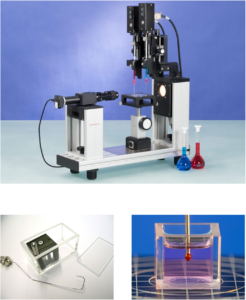
1. Overview
The Contact Angle / Pendant Drop Goniometer (DataPhysics OCA 11) is an optical measurement system used to analyze liquid–solid and liquid–liquid interfacial properties. It combines high-resolution imaging, precise liquid dosing, and contour analysis to determine key surface and interface characteristics of materials. This system is widely used in surface science, materials research, coatings, and quality control to quantify wettability and interfacial tensions.
Capabilities:
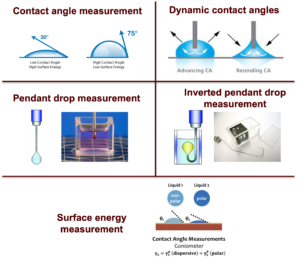
- Contact angle measurement
- Pendant drop/inverted pendant drop measurements
- Surface energy measurement
- Static and Advancing/Receding measurements
Features:
- High definition, high speed camera capable of recording > 3200 frames per second including movie recording
- Software: SCA 20 – sessile drop contact angle and advancing & receding contact angle by the needle-in method
- ESr-N Electronic Syringe Module for computer-controlled droplet delivery
- Hydrophobization coating Kit for needle

2. Principle
The OCA goniometer operates on optical drop shape analysis, where the shape of a liquid drop is captured and mathematically interpreted:
Contact Angle (Sessile Drop) Method:
- A small liquid droplet is deposited on a flat solid surface.
- The contact angle, the angle formed at the line where solid, liquid, and gas meet, reflects how well the liquid wets the surface.
- A high contact angle indicates low wetting (hydrophobic), while a low angle indicates high wetting (hydrophilic).
Pendant Drop Method:
- A liquid drop is suspended from a needle and deforms under gravity.
- The drop’s contour is captured and fitted using the Young–Laplace equation to determine surface tension or interfacial tension.
- The shape analysis correlates curvature to tension using drop profile fitting algorithms.
The accompanying software drives the measurement, performs real-time drop shape recognition, and outputs contact angle, surface tension, and surface energy data.
3. Data Interpretation
Primary measured quantities:
- Contact Angle (θ): A geometric measure of wetting; static, advancing, or receding values are reported. Static contact angle represents equilibrium wetting. Advancing/receding angles indicate hysteresis and surface heterogeneity.
- Surface Tension / Interfacial Tension:
Determined from the pendant drop’s shape using the Young–Laplace equation fit. - Surface Energy Components:
Using multiple liquids with known polar/dispersive properties, total surface energy and its components can be derived from measured contact angles via standard models.
Interpretation Notes:
- Higher contact angles indicate low surface energy or poor wetting, while lower angles suggest higher surface energy and strong wetting.
- Differences between advancing and receding angles indicate surface roughness, heterogeneity, or pinning effects.
- Pendant drop analysis provides direct liquid surface/interfacial tension, important for emulsion stability, coating formulation, and fluid processing.
4. Example Applications
Common research and industrial uses include:
- Surface Wettability & Coating Evaluation:
Quantifying how coatings, treatments, or surface modifications change wetting characteristics and optimizing adhesive, hydrophobic, or hydrophilic surface performance. - Surface Energy Determination:
Estimating total surface energy and polar/dispersive components of solids for material compatibility and adhesion predictions. - Liquid Surface Tension / Interfacial Tension:
Measuring liquid surface tension or interfacial tension in formulations of inks, oils, surfactants, and complex fluids using the pendant drop method. - Quality Control & Materials Characterization:
Evaluating consistency in production processes by automated contact angle mapping and surface energy profiling.
Investigating effects of surface cleanliness, treatments, or contamination.
Publications involving the Contact Angle Goniometer in the experimental conditions:
- Sessile drop and pendant drop tensiometry measurements