
1. Overview
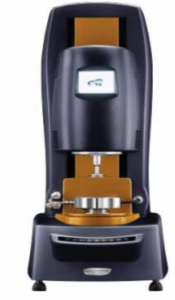
TA Instruments Discovery Hybrid Rheometer DHR-2 is a versatile, research-grade rheometer designed for precise measurement of viscosity and viscoelastic properties of liquids, melts, suspensions, emulsions, gels, and soft solids. It combines controlled-stress and controlled-strain modes, offering a broad torque range and high sensitivity suitable for complex fluids across research and industrial applications.
Capabilities:
- Viscosity flow curve, shear stress, strain, phase angle storage and loss modulus
- Viscoelasticity, yield stress, thixotropy, creep compliance and stress relaxation behavior
Features:
- Torque range: 0 to 200 mN.m
- Frequency range: 10-7 to 100 Hz
- Temperature range: RT to 200°C
- Maximum heating rate: 20°C/min

2. Principle
The DHR-2 applies a precise mechanical stress or strain to a sample and measures the resulting deformation or torque response.
Two primary operating modes
- Controlled-stress: stress imposed, strain response measured
- Controlled-strain: deformation imposed, stress response measured
Core rheological outputs
- Viscosity: resistance to flow under shear
- Shear thinning or thickening behavior
- Elastic (G′) and viscous (G″) moduli: from oscillatory tests
- Yield stress: stress threshold for flow onset
3. Data Interpretation
Common data representations include
- Flow Curves (viscosity vs shear rate): Newtonian, shear-thinning, shear-thickening behavior
- Amplitude Sweeps: linear viscoelastic (LVE) region determination
- Frequency Sweeps: G′ and G″ dependence on time scale
- Temperature Ramps: gelation point, melting, network transitions
- Creep and Recovery: long-time deformation and structural stability
- Yield Stress Analysis: defining flow onset
Interpretation highlights
- G′ > G″ indicates more elastic or solid-like behavior
- G″ > G′ indicates more viscous or liquid-like behavior
- Crossovers of G′ and G″ often correspond to gelation or structural transitions
- Viscosity decreases with shear rate for pseudoplastic systems
4. Example Applications
- Polymer melts and solutions: molecular weight effects, thermal transitions
- Paints, inks, coatings: shear thinning and leveling control
- Food products and dairy gels: texture, flow, yield stress
- Emulsions and dispersions: stability and particle interactions
- Hydrogels and biomaterials: gelation kinetics and viscoelastic strength
- Bitumen and asphalt binders: temperature-dependent rheology
- Pharmaceutical creams and suspensions: spreadability and flow
Publications involving the Rheometer system in the experimental conditions:
- Study of the viscosity, yield stress, and thixotropy of inks for 3D printing
- Structure–Processing–Property Relationships of 3D Printed Porous Polymeric Materials | ACS Materials Au
- Morphology map-guided identification of bijel ink for producing conductive porous structures | Matter
- 3D Printed CO2‐Based Triblock Copolymers and Post‐Printing Modification | Angewandte Chemie International Edition
- Thermo-mechanical characterization of salogels
- Temperature- and creep-resistant Diels-Alder salogels for shape stabilization of salt hydrate phase change materials |Journal of Materials Chemistry A
- Hybrid polymer salogels for reversible entrapment of salt-hydrate-based thermal energy storage materials |ACS Applied Engineering Materials
- Strong, thermo-reversible salogels with boronate ester bonds as thermal energy storage materials |Journal of Materials Chemistry A