
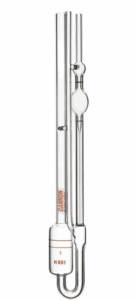
 1. Overview
The Ubbelohde Viscometer is a capillary-based, suspended-level viscometer used for precise measurement of the kinematic and intrinsic viscosity of polymer solutions, oils, and Newtonian fluids.
It provides high accuracy, minimal shear influence, constant hydrostatic head, and excellent repeatability, making it a standard instrument for polymer science, petrochemicals, and materials quality control.
Capabilities
- Minimum sample volume: 11 ml
- Minimum bath depth: 241 mm
- Viscosity range: 0.3-1.0 mm²/s (suitable for very thin liquids)
Features
-
- Measures the kinematic viscosity of transparent Newtonian liquids according to ASTM D445 and ISO 3104. (solvents, light oils, etc.)
- Calibrated constant of ~0.001 mm²/s² for direct conversion of flow time to viscosity
Sample Preparation & Measurement Procedure
- Select a suitable solvent or solution system and filter to remove particulates that may clog the capillary.
- Degas viscous or polymer samples if necessary to eliminate trapped air.
- Fill the viscometer gently using a pipette or syringe up to the indicated upper mark, avoiding bubbles.
- Place the viscometer vertically in a thermostatted bath at the target temperature and allow 10–15 min for thermal equilibration.
- Use suction (pipette bulb or vacuum) to draw the liquid slightly above the upper timing mark.
- Release the liquid and start timing when the meniscus crosses the upper mark; stop when it crosses the lower mark.
- Repeat at least three measurements and average the flow times for accuracy.
Notes & Tips
- Use clean and completely dry viscometers; residues alter flow behavior.
- For polymer or high-viscosity samples, maintain smooth, steady flow to avoid measurement artifacts.
- Tight temperature control (±0.1 °C) is critical because viscosity is highly temperature-dependent.
2. Principle
The Ubbelohde viscometer measures viscosity by recording the time required for a liquid to flow under gravity between two calibrated marks in a capillary tube.
Core concepts
- Flow time is proportional to viscosity and density
- Maintaining a constant hydrostatic head improves accuracy
- The instrument is immersed in a thermostatic bath to control temperature
- Using different tube sizes allows measurement over various viscosity ranges
Standard calculated parameters
- Kinematic viscosity (ν): based on flow time and instrument constant
- Relative and specific viscosity: comparison against pure solvent
- Intrinsic viscosity [η]: via extrapolation at zero concentration
3. Data Interpretation
Typical data outputs include
- Flow time (s): raw measurement between calibration marks
- Kinematic viscosity (mm²/s): product of flow time and viscometer constant
- Relative viscosity (ηr): ratio of solution viscosity to solvent viscosity
- Specific viscosity (ηsp): ηr – 1
- Reduced viscosity: ηsp / concentration
- Intrinsic viscosity [η]: extrapolated intercept for dilute polymer solutions
Interpretation guidelines
- Longer flow time indicates higher viscosity
- Temperature changes strongly affect viscosity; stability is crucial
- Intrinsic viscosity correlates with polymer molecular weight (Mark–Houwink equation)
- Deviations may indicate polymer degradation, aggregation, or solvent mismatch
4. Example Applications
- Polymer characterization: determining molecular weight via intrinsic viscosity
- Polymer solutions: concentration-dependent viscosity and chain conformation
- Petroleum and lubricants: kinematic viscosity for quality classification
- Food oils and bio-oils: temperature-dependent viscosity profiles
- Solvent studies and chemical processes: monitoring purity or formulation
- Academic research: dilute-solution hydrodynamics and polymer coil behavior