

1. Overview
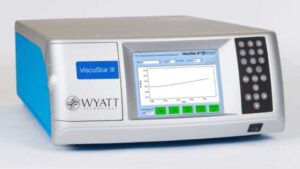
The WYATT ViscoStar III Viscometer and MicroDAWN Multi-Angle Light Scattering (MALS) Detectors form a powerful system for absolute characterization of macromolecules and nanoparticles in solution. This combined setup allows simultaneous measurement of molecular weight, size, conformation, and intrinsic viscosity, providing a complete picture of polymer, protein, or nanoparticle behavior. The system is widely used in biopharmaceuticals, polymer science, and nanomaterials research.
Capabilities of MicroDawn
- Determines the absolute molar mass of macromolecules eluting from SECs
- Measures the Radius of gyration
Features of MicroDawn

Capabilities of ViscoStar III
- Measures intrinsic viscosity
- Provides structural information (conformation, branching, etc) when combined with MALS
- High sensitivity at low sample concentrations
Features of ViscoStar III 
2. Principle
- ViscoStar III Viscometer: Measures intrinsic viscosity by monitoring the flow of solution through a capillary under controlled pressure. Viscosity is related to molecular size and shape, providing insight into polymer or protein conformation.
- MicroDAWN MALS Detector: Uses multi-angle light scattering to measure the intensity of scattered light at multiple angles. This allows determination of absolute molecular weight (Mw), radius of gyration (Rg), and second virial coefficient (A2) without the need for calibration standards.
- When combined, the viscometer and MALS detector provide a comprehensive hydrodynamic and molecular characterization, enabling accurate calculation of molar mass, size, branching, and shape parameters.
3. Data Interpretation
- Molecular Weight (MALS): Provides absolute Mw and polydispersity of polymers or proteins in solution.
- Radius of Gyration (Rg): Indicates the overall size and spatial conformation of macromolecules.
- Intrinsic Viscosity ([η]): Relates to polymer chain flexibility and branching; higher [η] often correlates with more extended molecules.
- Structure-Property Relationships: Combining MALS and viscosity data allows calculation of Mark–Houwink parameters (K and a), providing insights into molecular shape, aggregation, or conformational changes.
4. Example Applications
- Biopharmaceuticals: Determining aggregation, molecular weight distribution, and conformational stability of monoclonal antibodies and other protein therapeutics.
- Polymers: Absolute molecular weight and size determination of synthetic polymers, copolymers, and biopolymers.
- Nanoparticles: Characterizing size, shape, and molecular mass of functionalized nanoparticles or macromolecular complexes.
- Structure–Function Studies: Studying the relationship between polymer/protein conformation and solution behavior, stability, or performance.
- Quality Control: Routine analysis of molecular weight, polydispersity, and viscosity for research, development, and production processes.